

Image: Muhammad Raufan Yusup / Wikimedia Commons (CC0)
There is a moment in many solo businesses when growth stops feeling like progress and starts feeling like a ceiling. You are turning down work, answering emails at midnight and doing tasks you know someone else could handle. The business is healthy, but it cannot grow any further as long as every decision and deliverable runs through one person.
Moving from solo founder to small team is one of the riskiest transitions in a company’s life. Hire too early and payroll drains your cash. Hire too late and you burn out or lose clients. Hire without systems and your new teammate spends weeks guessing how things are done. The infographic below breaks the transition into seven steps, and the sections that follow explain how to work through each one with practical examples.
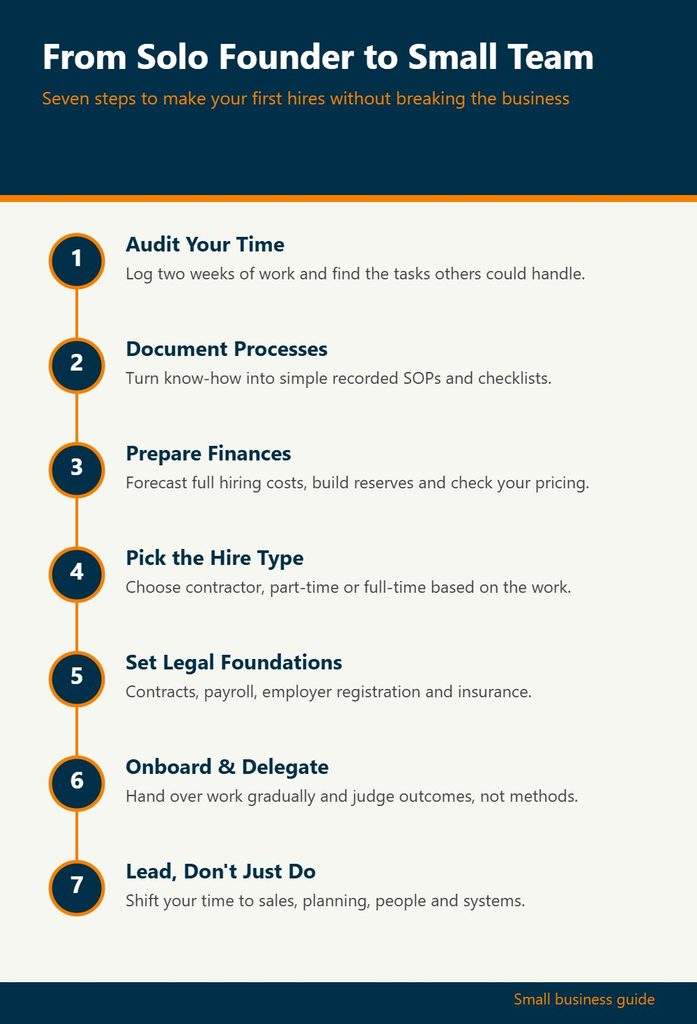
1. Audit Your Time and Find the Bottleneck
Before hiring anyone, figure out exactly where your hours go. Most founders are surprised by what they find.
For two weeks, log your work in blocks of thirty minutes. Then sort every activity into four groups:
- Work only you can do: high-level strategy, key client relationships, your signature skill.
- Work you are good at but others could learn: routine client delivery, proposals based on templates.
- Work you do poorly or slowly: perhaps bookkeeping, design or technical setup.
- Work that should not exist: manual tasks software could automate, meetings with no purpose.
The bottleneck is usually where groups two and three meet. A marketing consultant might discover she spends twelve hours a week formatting reports and scheduling posts. That is the work to hand off first, because it frees time she can sell at a higher rate. Eliminate group four before hiring; there is no point paying someone to do work that should not be done at all.
2. Document Your Processes
In a one-person business, processes live in the founder’s head. That works until someone else needs to follow them. Documentation is what turns your know-how into something a team can execute.
You do not need a thick operations manual. Start with the tasks you identified for handoff and create simple standard operating procedures (SOPs):
- Record yourself doing the task with a screen recording tool and narrate as you go. This is often faster than writing.
- Turn the recording into a checklist with clear steps, links to the tools involved and examples of finished work.
- Note decision points. Where do you use judgment? Write down how you decide, or flag those points for review.
- Store everything in one place, such as a shared drive folder or a knowledge base inside your project management tool.
Expect documentation to be imperfect at first. Your new hire’s questions are the best way to find gaps. Ask them to update the SOP whenever they learn something that was missing.
3. Get Your Finances Ready to Support Payroll
Adding people adds fixed costs. Before making an offer, be confident the business can carry them, including in a slow month.
Build a simple forecast covering the next twelve months. Include the new person’s pay plus the extra costs that come with employing someone, which can include payroll taxes, workers’ compensation insurance, benefits, equipment and software seats. Contractors are generally cheaper to add because they do not carry many of those costs, but they come with their own legal considerations, covered in the next step.
Ask yourself:
- Do I have a cash reserve that covers several months of the new cost, in case revenue dips?
- Will this hire generate or protect enough revenue to pay for themselves within a reasonable time?
- Are my prices high enough to support a team, or am I priced like a solo freelancer?
Many founders discover at this stage that a price increase needs to come before a hire. If you have been priced for one person’s overhead, adding a second person without raising rates squeezes your margin. For deeper reading on cash flow forecasting and business finance, GrowBizLab publishes practical guides aimed at small operators; to see them, go here and look through its finance section.
4. Choose the Right Hire: Contractor, Part-Time or Full-Time
Your first team member does not have to be a full-time employee. In fact, for many solo businesses, it should not be.
Freelancers and contractors
Contractors suit specialized or variable work: design, bookkeeping, web development, copywriting. You pay for output, they use their own tools and schedule, and you can scale up or down. The main caution is classification. Tax and labor authorities in many countries have tests for whether someone is truly an independent contractor or effectively an employee. The tests usually look at how much control you have over when, where and how the work is done. Misclassification can lead to back taxes and penalties, so if you are unsure, ask an employment lawyer or accountant.
Part-time employees
A part-time employee works well when you need consistent help with ongoing tasks and want someone integrated into the business, but do not yet have forty hours of work. It is also a lower-risk way to test whether a role is needed full-time.
Full-time employees
Full-time makes sense when the work is steady, central to the business and requires deep knowledge of your clients and processes. It is the biggest commitment and requires payroll setup, compliance with employment rules and usually some benefits.
Whichever route you choose, write a clear role description: outcomes you expect, tasks involved, hours, tools used and how success will be measured. Vague roles produce vague results.
5. Set Up the Legal and Admin Foundations
Hiring brings new obligations. Sorting them before your first hire starts saves headaches later.
For contractors, use a written agreement that covers scope, deliverables, payment terms, confidentiality and, importantly, ownership of the work produced. Without clear intellectual property terms, a contractor may retain rights to what they create for you.
For employees, the list typically includes:
- Registering as an employer with the relevant tax agencies
- Setting up a payroll system that handles withholding and filings
- Getting any required insurance, such as workers’ compensation
- Verifying work eligibility according to local law
- Displaying any required workplace notices
- Writing a simple employee handbook covering hours, time off, expenses and conduct
Requirements differ substantially by state and country, so check with your state labor department or a local adviser. Many payroll providers walk new employers through registration, which is a strong reason to use one rather than running payroll manually.
This is also a good moment to revisit your business structure. If you are still a sole proprietor, talk to an accountant or lawyer about whether forming an LLC or corporation makes sense now that you will have staff and more liability exposure.
6. Onboard and Delegate Deliberately
A great hire can still fail with a poor start. The first few weeks set the tone.
A simple onboarding plan:
- Before day one: set up accounts, devices and access to tools. Use individual logins, not shared passwords.
- Week one: explain the business, your clients and your standards. Walk through the SOPs together and have them shadow you.
- Weeks two to four: hand over tasks gradually, starting with lower-risk work. Review output closely and give specific feedback.
- Months two and three: widen responsibility. Shift from reviewing everything to spot-checking.
The hardest part for many founders is actually letting go. Delegation means accepting that someone else will do things differently, and sometimes less perfectly than you would, at least at first. Focus on outcomes rather than methods. If the result meets the standard, resist the urge to redo it your way.
Set up a regular rhythm of communication: a short weekly check-in to review priorities and remove obstacles, plus a shared project management tool where everyone can see who owns what and what is due. This reduces the constant interruptions that otherwise pull you back into the details.
7. Shift Your Role From Doer to Leader
The final step is internal. Once you have a team, your job changes. You are no longer only the person who does the work. You are the person who makes sure the work gets done well, keeps the business pointed in the right direction and creates conditions for your team to succeed.
That means spending more time on:
- Sales and relationships, so there is enough work to support the team
- Planning, including setting goals and tracking key numbers
- Hiring and developing people, including giving feedback and recognizing good work
- Improving systems, so the business runs more smoothly each quarter
Block time for this leadership work on your calendar, or it will be swallowed by urgent tasks. Many founders find a weekly planning session, perhaps an hour on Monday morning, keeps them focused on the bigger picture.
It is also normal to feel uncomfortable during this shift. Founders who loved the craft may miss doing it all day. Keep a small piece of the work you enjoy most, if that is realistic, while letting the team handle the rest. If you want reading on management tools, contracts and the software that helps small teams coordinate, GrowBizLab covers those topics in its how-to guides; learn more by browsing its business and software sections.
Common Mistakes When Making the First Hire
Founders who have been through this transition often point to the same missteps:
- Hiring a clone. Bringing on someone with the same strengths as you leaves the same gaps. Hire to complement your weaknesses.
- Waiting for the perfect moment. There is rarely one. If the time audit shows you are the bottleneck and the finances work, move forward.
- Skipping the trial period. A paid test project or short initial contract, where legally appropriate, reveals far more than an interview.
- Delegating tasks but not authority. If every small decision still needs your sign-off, you have added a person without removing the bottleneck.
- Neglecting culture. Even a team of two has a culture. Be clear about how you communicate, how quickly you respond to clients and what quality means.
Scaling from one person to a few is less about a single hiring decision and more about building a business that does not depend on you for everything. Work through these steps in order, revisit them as you add each new person, and the transition becomes a series of manageable moves rather than one leap into the unknown.