
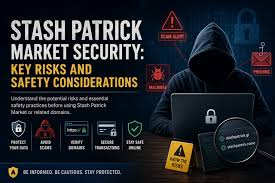
The growth of online marketplaces has transformed how people communicate, shop, manage finances, and exchange information. stash patrick At the same time, the expansion of digital commerce has created new challenges involving privacy, authentication, data protection, and cybersecurity. These concerns become particularly important when discussing underground marketplaces and services associated with cybercrime.
The name Stash Patrick may appear in online discussions involving underground marketplaces, payment-card information, or dark-web activity. stashpatrick.cc Such references should be approached carefully. A name, domain, or online claim does not automatically establish that a service is legitimate, secure, active, or trustworthy. Instead, the topic provides an opportunity to examine broader principles surrounding online access, privacy, and marketplace security.
This article explores these issues from a cybersecurity-awareness perspective without providing instructions for accessing illicit services.
Understanding Online Marketplace Access
Access is one of the first security concerns associated with any online marketplace. Legitimate platforms typically use account registration, password authentication, multi-factor authentication, and other controls to protect users.
Underground marketplaces may operate differently. Some attempt to conceal their infrastructure or users, while others may rely on anonymous communication channels. However, anonymity does not guarantee safety.
Users of suspicious platforms can encounter phishing pages, malware, fraudulent administrators, scams, or stolen credentials. A person searching for an underground service may even become a victim of another criminal before reaching the intended destination.
This demonstrates an important cybersecurity principle: an environment designed to provide anonymity should not automatically be assumed to provide trustworthy security.
The Stash Patrick Context
Stash Patrick can be considered within broader discussions about underground online marketplaces and illicit payment-card activity. However, information surrounding such services can be difficult to verify.
Criminal operations frequently change domains, names, communication channels, and infrastructure. Some disappear entirely, while others may reappear under different identities.
There may also be fraudulent websites that imitate well-known underground names. These sites can be created specifically to steal passwords, cryptocurrency, personal information, or other sensitive data.
For researchers and security-conscious users, the focus should therefore remain on understanding the risks rather than attempting to interact with questionable services.
Privacy and the Modern Internet
Privacy has become increasingly important as more personal information moves online.
Websites, applications, financial institutions, retailers, and social networks may collect information about users for legitimate business and security purposes. At the same time, unauthorized access to this information can create significant risks.
Privacy protection involves understanding what information is being collected, why it is collected, how it is protected, and who may have access to it.
Users should review privacy settings on important accounts and avoid providing unnecessary personal information.
Why Privacy Does Not Equal Anonymity
Privacy and anonymity are related but different concepts.
Privacy generally involves controlling who can access information about an individual. Anonymity involves concealing the identity of the person behind an activity.
A service may provide some degree of anonymity while still failing to protect users from fraud or data theft.
Underground marketplaces demonstrate this distinction clearly. Even when participants believe their identities are concealed, they may still be vulnerable to scams, malicious software, compromised accounts, or security breaches.
Consequently, users should not assume that anonymity technologies eliminate cybersecurity risks.
Marketplace Security and Authentication
Strong authentication is fundamental to protecting legitimate online marketplace accounts.
Users should create unique passwords for important services and avoid reusing credentials across websites. Password managers can help generate and store strong passwords.
Multi-factor authentication provides another layer of protection. Depending on the platform, users may be asked to provide a code, approve a notification, use an authentication application, or present another approved credential.
For businesses, strong authentication should be particularly important for administrative accounts because those accounts may provide access to customer records, payment systems, or other sensitive resources.
Phishing as a Major Threat
Phishing remains one of the most common methods for stealing online credentials.
Attackers may create convincing messages that appear to come from marketplaces, banks, payment providers, or technology companies. The message may ask the recipient to confirm an account, resolve a payment issue, or reset a password.
The included link can lead to a fraudulent login page designed to capture credentials.
Users should be suspicious of unexpected login requests and verify websites independently before entering sensitive information. Instead of following an unsolicited link, accessing the official application or manually entering a verified website address can reduce risk.
Protecting Payment Information
Payment information requires particularly strong protection because unauthorized access can result in financial fraud.
Consumers should monitor transaction histories and enable alerts when available. Suspicious transactions should be reported promptly to the relevant financial institution.
Businesses should limit access to payment information and use appropriate security technologies to protect customer data.
Tokenization, encryption, access controls, fraud monitoring, and secure authentication can all contribute to safer payment environments.
Risks to Businesses
Businesses operating online marketplaces face threats from both external attackers and internal security weaknesses.
A compromised employee account could provide attackers with access to customer information or administrative systems. A software vulnerability could expose sensitive databases. A phishing campaign could capture employee credentials.
Organizations should therefore use layered security controls.
Regular vulnerability assessments, security updates, access reviews, employee training, and network monitoring can help identify potential weaknesses before they become major incidents.
Incident Response and Recovery
No security system can guarantee that an organization will never experience a breach. Effective incident response is therefore essential.
Businesses should have documented procedures for identifying suspicious activity, containing affected systems, investigating incidents, notifying appropriate parties, and restoring operations.
Consumers should also know what to do if an account appears compromised. Changing passwords, enabling multi-factor authentication, reviewing account activity, and contacting financial institutions when necessary can help limit potential damage.
The faster a compromise is detected, the more opportunities there may be to prevent further misuse.
Threat Intelligence and Underground Markets
Cybersecurity researchers often monitor underground-market activity to understand emerging threats.
Threat intelligence can help identify compromised credentials, malicious infrastructure, phishing campaigns, and other indicators associated with cybercrime.
The purpose of responsible research is defensive. Information gathered from threat intelligence can help organizations determine whether their customers, employees, systems, or domains may be affected.
This type of monitoring is particularly useful because underground markets can evolve rapidly.
Building Better Digital Security Habits
Individuals can improve their security through relatively simple habits.
Using unique passwords, enabling multi-factor authentication, keeping software updated, avoiding suspicious links, and monitoring financial accounts are all practical steps.
Businesses should combine these habits with stronger organizational controls. Employee education, access management, security monitoring, encryption, backups, and incident-response planning are important components of a mature security program.
Security should also be reviewed regularly because threats change over time.
The Future of Marketplace Security
Online marketplaces will continue evolving alongside technology. Artificial intelligence, automated fraud detection, biometric authentication, behavioral analytics, and improved identity-management systems may strengthen digital security.
However, attackers will also adapt. Social engineering and credential theft are likely to remain significant threats because they target human behavior rather than technology alone.
The future of marketplace security will therefore require cooperation between users, businesses, payment providers, technology companies, and cybersecurity professionals.
Conclusion
Stash Patrick can be discussed as part of the broader cybersecurity conversation surrounding underground marketplaces, privacy, payment information, and online access. However, individual names and domains are less important than understanding the underlying security challenges.
Privacy does not guarantee safety, and anonymity does not eliminate the possibility of fraud or account compromise. Users should rely on legitimate marketplaces, protect their credentials, enable multi-factor authentication, and remain cautious about suspicious websites and messages.
Businesses must similarly protect customer information through strong authentication, access controls, monitoring, secure payment systems, employee training, and effective incident response.
Ultimately, secure marketplace access depends on multiple layers of protection. By understanding the relationship between privacy, authentication, and cybersecurity, individuals and organizations can make safer decisions in an increasingly connected digital economy.